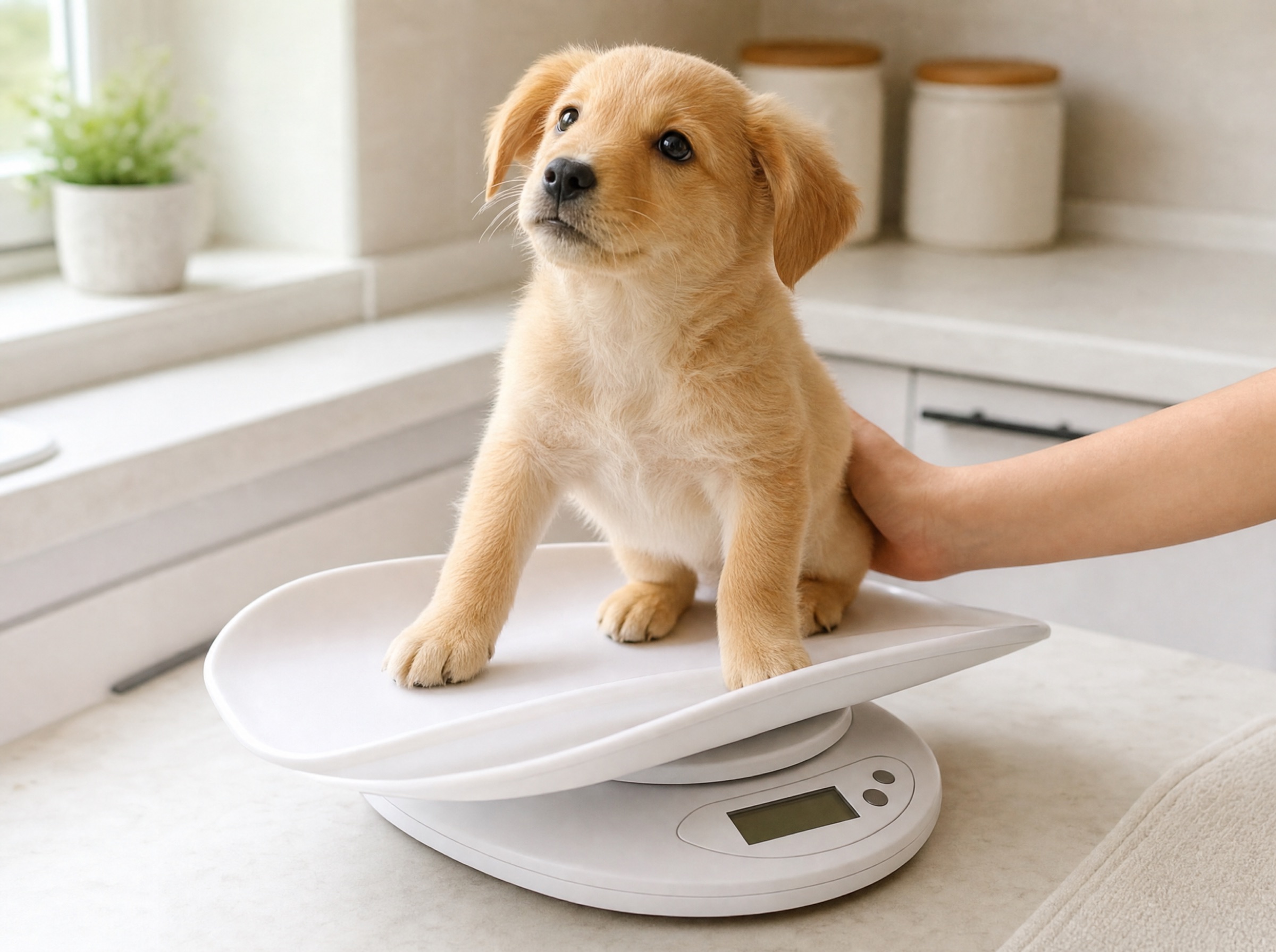
Small fluffy puppy sitting on a kitchen scale with curious alert expression

What will your puppy weigh as an adult?

Enter puppy age, current weight, and breed size. The calculator returns an adult-weight planning range — not a single number — because puppy growth varies. Mixed and giant breeds get wider ranges on purpose.

Updated May 15, 2026

Before you start

  • Puppy age in months
  • Current weight on a scale
  • Breed or likely adult size class
  • Whether the puppy is a mixed breed
  • Body condition or growth concern, if any
  • Vet growth record, if you have one
Puppy weight todaylb or kg, weigh on a scale
lb
Agemonths (decimals OK — 2.5 = 10 weeks)
mo
Expected adult sizebest guess from breed or parents
Known purebred?single recognized breed = narrower band

Likely adult weight

2635lb

Most likely around 30 lb. Medium dogs usually finish growing around 12 months.

At 4 mo

12.817.3 lb

At 7 mo

20.727.9 lb

At 9 mo

23.531.7 lb

Full grown

25.534.5 lb

Why this band
  • Known purebred — breed-specific growth curves narrow the band.

A range, not a single number — that's the honest version. Mixed-breed puppies surprise you both directions. The methodology page walks through the math. See methodology

Waltham growth curves·AKC breed standards·AAHA puppy life-stage

Why this is a range, not a promise

Puppies grow on a curve, not a straight line, and the curve varies. Breed size, genetics, sex, nutrition, health, and spay or neuter timing all push individual puppies above or below the typical line. Two purebred siblings can finish growing several pounds apart and both still be tracking normal puppy development.1

The calculator handles that uncertainty by returning a low-to-high range instead of a single confident number. Wider bands mean less certainty — large, giant, and mixed-breed puppies all get wider bands on purpose. Treat the output as an estimate and a planning range, not a forecast of the exact adult weight. Ask your vet if growth changes suddenly or feels off between visits.

Growth pattern by size

Pick the size group that fits your puppy's likely adult size. Each group has its own growth curve — fast and short for toy and small breeds, long and slow for giant breeds. Mixed-breed puppies sit somewhere in between with extra uncertainty.1

Toy & small

under ~25 lb

Full grown around 9–12 months

Mature fastest. At 4 months a small puppy is already around 60% of adult weight, so the calculator settles quickly.

Medium

~25–55 lb

Full grown around 12–14 months

Steady middle path. The classic 'double the 4-month weight' shortcut sits closest to medium breeds.

Large

~55–90 lb

Full grown around 14–18 months

Longer growth curve. A 4-month-old large breed is only around 42% of adult weight — fast early growth can stress joints.

Giant

90+ lb

Full grown around 18–24 months

Slowest growth, highest need for vet-guided puppy nutrition. Foods labeled for large-breed puppy growth target slower, steadier gains.

Mixed-breed

varies

Full grown around varies

Wider uncertainty. Pick the size class your puppy looks closest to and treat the band as wider. A known parent weight tightens it.

Breed and mix notes for common puppy-weight searches

Short notes on the breeds and mixes owners most often ask about. Each one explains why the calculator range can run wider for that family, and what input choices to use. All of this lives on the same calculator — you don't need a different page per breed.

Bernedoodle and doodle mixes

Doodle puppies can be hard to predict because the poodle parent comes in three sizes — toy, miniature, standard — and the Bernese, Golden, or Lab parent stays in the same large frame. A standard Bernedoodle usually settles in the Large band; mini doodles drop into Small or Medium. Coat fluff also makes them read heavier on a casual look than they actually are on a scale.

What to enter: Set purebred to No / mixed. Pick the size class of the larger parent. Add a parent weight if known — it does more for a doodle than any breed-specific guess.

Cavapoo and small poodle mixes

Cavapoos, Maltipoos, and similar small-poodle mixes usually finish in the Small band — most land between toy and small. Variation comes from how recently a standard poodle sits in the pedigree; a first-generation Cavapoo from a toy or miniature poodle parent stays small, while a multigen line with a larger poodle ancestor can push into the high end of Small.

What to enter: Pick Small. Set purebred to No / mixed. If you can confirm both parents are small breeds, the band will still widen but it stays within the small range.

Chiweenie and tiny mixes

Chiweenies (Chihuahua × Dachshund), Yorkie mixes, and other tiny crosses typically finish in the Toy or Small band. The mix usually means a longer body and shorter legs than a purebred Chi, but adult weight stays low. Watch for early weight gain in adulthood — short-legged frames carry extra pounds harder than tall ones do.

What to enter: Pick Toy or Small depending on the parent sizes. Set purebred to No / mixed. The band will be narrow because the absolute weight is low to begin with.

Great Dane and giant puppies

Great Danes, Mastiffs, Saint Bernards, and other giants are still growing well past the age when smaller breeds are finished. A 4-month giant puppy is well under half its adult weight, and the curve keeps climbing through the second year. The calculator widens the band on purpose because the late-growth portion of the curve carries the most uncertainty.

What to enter: Pick Giant. Keep purebred set to Yes if the pedigree is known. Re-weigh at 4, 6, 9, and 12 months — the projection tightens as the puppy moves up the curve.

German Shepherd and working breeds

German Shepherds, Labradors, Golden Retrievers, Belgian Malinois, and similar working breeds usually settle in the Large band. Males often finish heavier than females, and working-line dogs may look leaner than show-line dogs at the same age. The growth curve runs from 12 to 18 months for most of this group.

What to enter: Pick Large. Set purebred to Yes if the pedigree is known. Sex isn't a calculator input, so expect females to land near the low end of the band and males near the high end.

Mixed-breed puppy when parents are unknown

Shelter and rescue puppies often arrive with no pedigree at all. Paws, ear set, and weight at the current age give a rough size-class guess, but every part of the read is more uncertain than a known mix. Re-checking the estimate every two to four weeks is the best way to tighten the range as the puppy grows.

What to enter: Pick the size class your puppy looks closest to. Set purebred to No / mixed. If the rescue can share the mom's adult weight, add it — that one input tightens the band more than any breed guess.

For 20 common purebreds with full weight ranges, scroll to the adult-weight-by-breed table below.
What the estimate is useful for

A puppy weight estimate is a planning tool. It works best as a way to size purchases and watch trends — not as a replacement for vet growth tracking.

  • Crate sizing. Buy the adult-size crate from the start using the high end of the band so the dog has room as they grow.
  • Harness and collar planning. Adult-size estimates set realistic targets for the next harness and collar size, instead of replacing both every two months.
  • Food budget. An adult dog at the projected weight has a daily calorie target — the dog calorie calculator turns that into cups per day, which sets a realistic monthly food budget.
  • Adult-size fit for apartments, cars, travel, and grooming. Knowing the projected adult size helps you plan around lease weight limits, vehicle crate space, airline carrier rules, and groomer pricing tiers — all of which step up at specific weights.
  • Cue for the puppy-to-adult food switch. The full-grown age is the natural moment to talk with your vet about moving from puppy formula to adult food, and to start the calorie calculator at the new adult target.

When the number deserves a vet check

One out-of-range estimate is not a diagnosis — the calculator can't see a specific puppy. These are the patterns worth calling your vet about rather than waiting:

  • Sudden weight loss, or no gain across two or more weigh-ins a couple of weeks apart.
  • Rapid weight gain alongside a pot belly, poor coat, or generally poor body condition.
  • Poor appetite, vomiting, diarrhea, or lethargy — especially if any of these show up alongside a weight change.
  • A large- or giant-breed puppy growing very fast — most vets target steady, not fast, growth in these breeds because joints and bones develop at their own pace. Ask your vet about large-breed puppy food and whether extra calcium should be avoided.2
  • A puppy much smaller or much larger than littermates at the same age.
  • Anything that worries you. The estimate is a planning tool, not a diagnosis — call your vet when growth feels off.

Worked examples

Three example reads — not specific puppies, but the shape of what the calculator typically shows in each situation.

Example

Small mixed-breed puppy, unknown parents

Pick the Small band and set purebred to No / mixed. The calculator returns a wider low-to-high range than a purebred Small would — that wider band is the honest read when you don't know what's in the mix. Small puppies are also already most of the way to adult weight by 4 months, so the range tightens fast as you re-weigh.

What to do: Use the high end of the band for adult crate and harness sizing. Easier to right-size down than to upgrade later.

Example

Doodle or medium-to-large mix

A Bernedoodle, Goldendoodle, or Labradoodle puppy usually sits in the Large band when the non-poodle parent is a Bernese, Golden, or Lab — mini and toy doodles drop into Small or Medium. Set purebred to No / mixed and the band widens. If you have a parent weight, add it; one known parent does more for accuracy on a doodle than any breed-specific tweak.

What to do: Re-check the estimate at the 4 and 6 month weigh-ins. Doodle coats and frames vary widely from generation to generation, and the range will narrow as the puppy grows.

Example

Giant-breed puppy on a long growth curve

Pick the Giant band. The calculator returns a substantial adult weight but the curve is long — a 4-month giant-breed puppy is well below half its adult weight, and the calculator will keep widening the range until growth slows in the second year. Slow, steady growth is what most large- and giant-breed vets aim for.

What to do: Talk with your vet about large-breed puppy food and whether extra calcium should be avoided. Ask about growth rate at routine visits.

Questions worth asking

How accurate is a puppy weight calculator?

It is a planning tool, not a measurement. The output is a low-to-high range, not a single fixed number. Purebreds with a known size class get a tighter band; mixed-breed puppies and giant breeds get a wider one. The 3–6 month window gives the most useful read — earlier than that, week-to-week weight swings are too big to project from.

How can I estimate mixed-breed adult weight?

Pick the adult size class your puppy looks closest to and treat the band as wider on purpose. If you know either parent's adult weight — sometimes a shelter or breeder can share the mom's size — drop it into the optional parent-weight field. One known parent weight is the strongest single input after age and current weight. Re-check the estimate every few weeks as the puppy grows.

When do puppies stop growing?

Toy and small breeds usually finish around 9–12 months. Medium breeds settle around 12–14 months. Large breeds keep building bone to 14–18 months. Giant breeds can still be growing at 18–24 months. These are typical ranges, not deadlines — individual puppies finish on their own schedule.

Why did the estimate change after a new weigh-in?

The calculator re-reads the curve every time you change inputs, so a fresh weight at a new age pulls the projection toward the line your puppy is actually growing on. A small shift between weigh-ins is part of how the range works. A large jump can mean a measurement error (different scale, full belly), a real growth spurt, or a puppy that is sitting higher or lower in the band than first guessed.

Is my puppy overweight or just growing fast?

Body shape tells you more than the number alone. A puppy that has a visible waist from above, ribs you can feel without pressing, and a tucked belly from the side is usually tracking growth well. A round belly with no waist, ribs hidden under a thick layer, or rapid gains in a large or giant breed are worth asking your vet about at the next visit.

What should I enter for a Bernedoodle, Cavapoo, or mixed breed?

Pick the adult size class your puppy is likely to land in based on the parent breeds. A standard-poodle Bernedoodle or Goldendoodle usually fits the Large band; mini and toy doodles fit Small or Medium; Cavapoos and Chiweenies typically sit in Small. Set the purebred toggle to No / mixed so the calculator widens the band, and add a parent weight if you have one — that input does more for accuracy on a mix than any breed-specific tweak.

Adult weight by breed

Typical adult weight ranges for 20 popular breeds — use them to pick the right size class above. The drift column flags the body-shape pattern vets see most often in each breed.3

Breed weights with body-shape notes

Pick a size tier to filter. Numbers are AKC standards; the drift column is the pattern vets see most often in that breed.

BreedMaleFemaleCommon drift
French Bulldogunder 28 lbunder 28 lbBrachycephalic plus low exercise tolerance — body shape 6–8 is common; extra fat compounds airway and heat issues.
Yorkshire Terrierup to 7 lbup to 7 lb"Teacup" marketing pulls the breed past the 7-lb cap; pet Yorkies often run 8–12 lb. Coat hides drift.
Dachshund (standard)16–32 lb16–32 lbIVDD (back-disc) risk scales with abdominal load — vets aggressively flag body shape 6 or higher in Dachshunds.
Pug14–18 lb14–18 lbTop-three obesity-prone breed in clinical surveys — food-motivated, brachycephalic, sedentary by build.
Pomeranian3–7 lb3–7 lbShow ring 4–6 lb; pet Poms drift to 8–12 lb. Dense coat hides body shape — palpate, don't eyeball.
Beagle20–30 lb (15")20–30 lb (15")Used as the obesity research model — opportunistic over-eaters, regularly top obesity-prevalence rankings.
Australian Shepherd50–65 lb40–55 lbSuburban Aussies under-exercised vs working-line genetics — gain abdominal fat fast.
Pembroke Welsh Corgiup to 30 lbup to 28 lbChondrodysplastic long back — every excess pound directly loads the spine.
Border Collie30–55 lb30–55 lbUsually under-ideal, not over — outworks the bowl. Pattern reverses for retired or older BCs.
Boxer65–80 lb≈50–65 lbLean working build is breed-correct; cardiac-disease prevalence narrows the over-ideal margin.
Labrador Retriever65–80 lb55–70 lbAbout 25% of Labs carry a POMC gene deletion that encodes constant hunger — adult Labs at body shape 7–9 is the clinical norm.
Golden Retriever65–75 lb55–65 lbTreat-heavy training tradition; body shape drift typically shows up after age four when activity drops.
German Shepherd Dog65–90 lb50–70 lbAmerican show lines run heavier; over-ideal compounds existing hip and elbow dysplasia load.
Doberman Pinscher75–100 lb60–90 lbLean visible-musculature build is breed-correct — owners often misread it as "underweight" and over-feed.
Siberian Husky45–60 lb35–50 lbBred to run 100+ miles a day on minimal food — most pet huskies need far less kibble than generic calculators predict.
Standard Poodle60–70 lb40–50 lbCoat hides body shape; over-ideal stresses the breed's orthopedic predispositions.
Rottweiler95–135 lb80–100 lbHip dysplasia and cruciate rupture risks are both weight-sensitive — vets target body shape 4–5 hard in this breed.
Bernese Mountain Dog80–115 lb70–95 lbMedian lifespan is short (7–8 years) — every excess pound shortens an already-short window.
Great Dane140–175 lb110–140 lbPuppy growth-rate management matters more than adult weight; the calorie load required to over-feed an adult is enormous.
Mastiff (English)160–230 lb120–170 lbLine between "breed-correct heavy" and "over-ideal" requires palpation, not eyeball — coat and bone hide a lot.
Weights from AKC breed standards. Drift notes from clinical-prevalence surveys (APOP, Banfield) and breed-specific veterinary literature — see Sources below.

Related calculators

  • Puppy growth calculator — same engine, month-by-month growth-curve view instead of the single adult-weight read.
  • Dog calorie calculator — puppy life stage drives a 2–3× calorie multiplier over an equivalent adult dog. Useful once you have a projected adult weight.
  • Dog ideal weight calculator — for adult dogs already finished growing, the body-shape read that tells you whether today's weight is on target.
  • Dog age calculator — translate puppy and adult ages into life-stage terms so the weight number sits in context.
  • When do puppies stop growing — size-class timing for the full-grown milestone in plain English.

Sources

Full source list with verbatim quotes lives at /methodology. Specific to this calculator:

  1. 1. WALTHAM Petcare Science Institute — puppy growth charts and breed-specific growth-curve research; canonical reference for size-class growth percentages and full-grown timing. waltham.com/resources/puppy-growth-charts
  2. 2. AAHA Nutritional Assessment Guidelines — puppy life-stage feeding and slow-growth targets for large- and giant-breed puppies. aaha.org nutritional assessment
  3. 3. American Kennel Club — breed weight standards used for the adult-weight-by-breed table. akc.org/dog-breeds

Ask a PetMathStudio question

Calculator help for PetMathStudio's pet nutrition, toxicity, growth, age, and pregnancy tools — RER × MER, body condition scoring, food density, and life-stage multipliers. Free, no signup. Not veterinary advice — for medical, feeding, or weight-loss decisions about your specific pet, talk to a licensed veterinarian.

Hi, I'm the PetMathStudio assistant. I answer questions about pet calorie, weight, age, and feeding math — and how the calculators on this site work. I'm not a veterinarian and I can't give personal veterinary advice. For weight-loss programs, prescription diets, or age-related illness, talk to a licensed veterinarian.