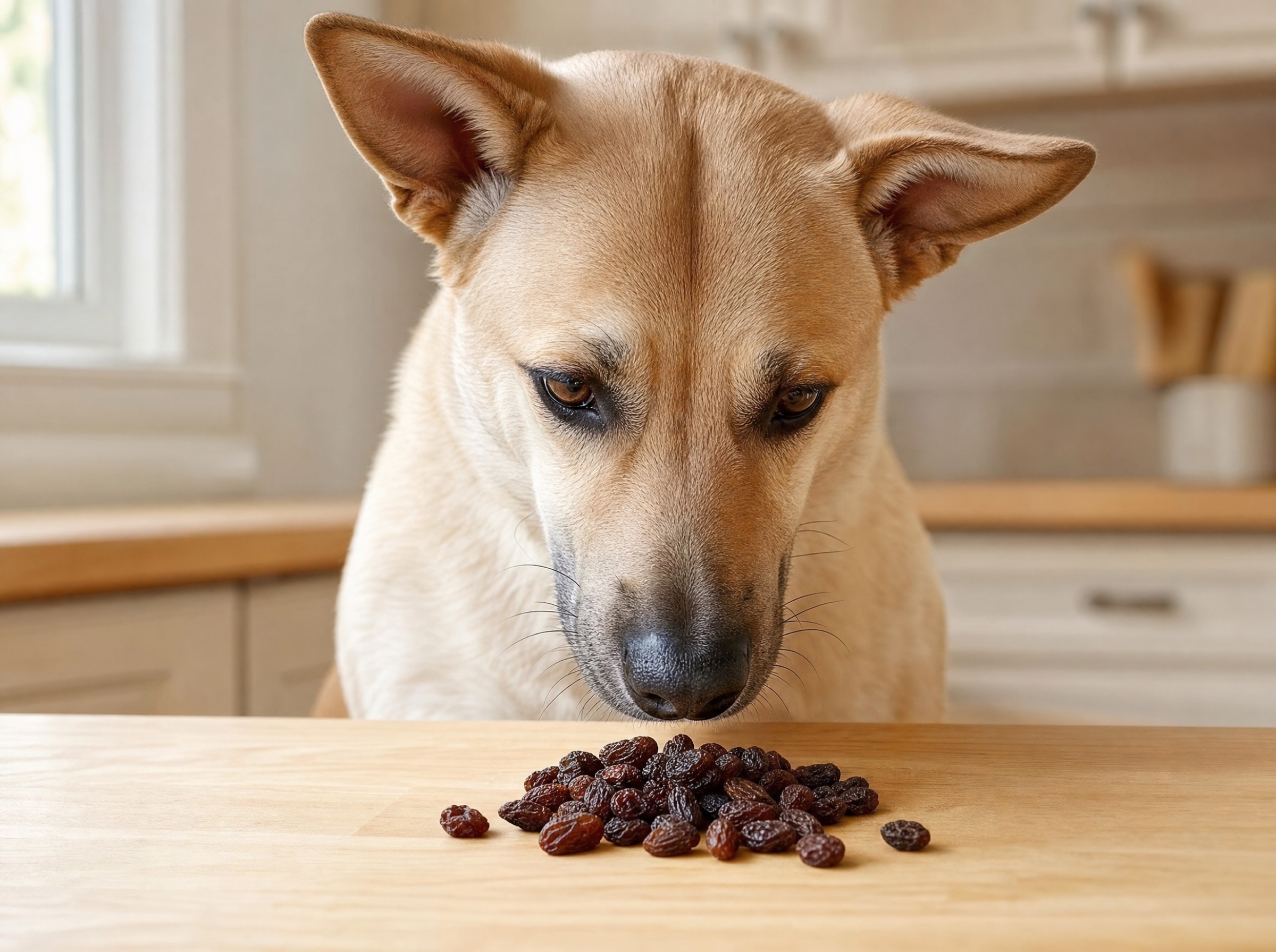
Did your dog eat raisins or grapes? Type in their weight and how many. We'll show how serious it is — but call your vet either way. Same toxin, same threshold, no safe dose.
Updated May 25, 2026
Dog weightlb or kg, weighed on a scale
lb
Fruitsame per-piece threshold for both
How many raisins?best estimate is fine
raisins
Below documented threshold
Call your vet anyway — no safe dose exists.
The amount is below the threshold Cornell cites for likely toxic effects, but individual dog sensitivity varies a lot. Some dogs have developed kidney injury from as few as 4-5 grapes. Call your vet or ASPCA Poison Control: (888) 426-4435.
1.0 raisin per 30 lb dog = 0.33 per 10 lb of body weight.
Cornell/Merck triage threshold: more than 1 grape or raisin per 10 lb of body weight. The same per-piece threshold applies to both forms.
Raisins are dehydrated grapes — per-gram concentration is higher, but Cornell's published triage threshold is the same per piece. Treat any raisin ingestion as seriously as a grape.
No safe dose has been established. Individual sensitivity varies — call your vet regardless of count.
This calculator is a triage tool, not a substitute for professional veterinary advice. The toxic dose of grapes and raisins is unpredictable — sensitivity varies a lot between dogs. When in doubt, call.
ASPCA APCC·Cornell Vet·Merck Vet Manual
What to do if your dog ate raisins — step by step
The next 60 minutes matter most. Treatment works best if it starts before symptoms appear, so the first call is not optional — even if your dog seems fine right now.
1. Estimate the number of raisins. If your dog ate raisin bread, oatmeal raisin cookies, or trail mix, count the visible raisins in what's left and check the package for serving size. A photo of the package helps the vet.
2. Weigh or estimate your dog. If you don't have a recent weight, the calculator above accepts your best estimate. Closer is better.
3. Call your local emergency vet first. They can tell you whether to come in immediately or call a 24/7 toxicology line for triage instructions.
4. If your vet isn't reachable, call poison control. ASPCA Animal Poison Control at (888) 426-4435 or Pet Poison Helpline at (855) 764-7661. Both charge a per-case fee and can give you a case number to share with your vet.
5. Do not induce vomiting at home without veterinary direction. Whether vomiting is safe depends on your dog's weight, symptoms, and time since ingestion. The wrong home treatment can create a separate emergency.
6. Bring your dog in if instructed. Treatment may include veterinary-induced vomiting, kidney monitoring, and IV fluids for at least 48 hours. Bring the package, the poison-control case number, and any recent bloodwork.
7. Watch for delayed symptoms even if treated. Vomiting and diarrhea often appear first. The more serious kidney window is later: decreased urination, increased thirst, lethargy, or weakness in the next 24-72 hours means call back immediately.
The published threshold is a trigger for emergency triage, not a safety zone. Sensitivity varies between dogs, there is no antidote once kidney injury starts, and treatment becomes harder the longer it waits. If your dog ate raisins, the right answer is always: call.
What the published threshold actually says
MSD/Merck lists a practical triage threshold: "more than 1 grape or raisin per 4.5 kg (10 pounds) of body weight may contain enough tartaric acid to pose a risk for renal effects." One sentence, both fruit forms, same per-piece number. Cornell adds the owner-facing rule that any ingestion should be treated seriously because the exact toxic dose is not predictable. This calculator follows the published threshold while still treating every raisin ingestion as a vet-call event.
Raisins are dehydrated grapes — the water leaves but the tartaric acid stays. By weight, a raisin is more concentrated than a grape. Some older rule-of-thumb articles take that fact and infer a 3× per-piece raisin multiplier, but MSD/Merck does not publish a separate raisin number for this triage threshold. The published threshold treats the two forms identically per piece.
One opinion worth having: raisins are easier to spill, scatter, and lose under the couch than grapes. Most cases of raisin ingestion vets see are dogs finding raisins that fell out of granola bars, oatmeal cookies, or hot cross buns. Be aggressive about cleanup — and treat any raisin ingestion as just as serious as a grape one, not less.
How many raisins is too many for your dog's weight?
The number is not the same for every dog. MSD/Merck lists a practical risk threshold for both raisins and grapes: more than 1 piece per 10 pounds of body weight. Below that line is not safe — it is just below the documented risk threshold. Cornell warns that sensitivity varies between dogs and any ingestion should be treated as serious.
Dog weight
MSD/Merck risk threshold
Real-world context
10 lb
More than 1 raisin
One raisin is close enough to treat seriously; 2 raisins is over the published threshold. Toy breeds can be at risk from a single piece.
20 lb
More than 2 raisins
A small handful from a granola bar can go over the line.
30 lb
More than 3 raisins
One oatmeal raisin cookie with 5-10 raisins is well over.
50 lb
More than 5 raisins
One slice of raisin bread with 5-15 raisins may be at or over the line.
80 lb
More than 8 raisins
A full handful or one cookie can reach the threshold.
This table reflects the documented threshold, not a safety zone. Smaller dogs hit the threshold with fewer pieces, and very small dogs under 10 pounds can be at risk from a single raisin. Use the calculator above for the risk-tier output for your dog's exact weight and piece count.
How many raisins are in 30 grams?
About 50 to 75 raisins. This calculator uses a rough 0.4 to 0.6 grams per raisin estimate, so a 30-gram amount is close to a 1-ounce snack box. The emergency threshold is not a grams-per-kilogram dose; count pieces when you can and use grams only to reconstruct the count.
Raisins eaten
Rough gram estimate
What to tell the vet
1 raisin
about 0.5 g
One piece. Include the dog's weight and time eaten.
10 raisins
about 5 g
Ten pieces. This reaches the published threshold for a 100-lb dog and exceeds it for smaller dogs.
30 g raisins
roughly 50-75 raisins
Give both numbers. If the package weight is the only known amount, use it as the upper-bound estimate.
This conversion is intentionally rough. Raisin size varies. If the count is uncertain, use the higher estimate when you call.
Common hidden raisin sources
Oatmeal raisin cookies. Each cookie typically packs 5-10 raisins. Plus extra fat and sugar that compound any GI upset.
Raisin bread. A slice carries 5-15 raisins. Hot cross buns at Easter are a common emergency-vet source.
Trail mix. Often pairs raisins with chocolate and macadamia nuts — three toxins at once. Worst-case combination.
Granola bars.Many varieties have raisins. Even "chocolate chip" flavors sometimes hide a few.
Currant scones / fruit cake / Christmas pudding. Currants are technically Zante grapes — count them as raisins for risk purposes.
Cereal with raisin clusters. Raisin Bran types. Easy to leave bowls within reach.
Grape derivatives: wine, juice, jelly, and jam
Anything made from grapes carries the same tartaric acid risk because the toxin survives pressing, fermentation, drying, and cooking. Wine adds an alcohol risk on top — even small amounts of alcohol are dangerous to dogs and compound the kidney load. Grape juice is the highest-concentration form short of pure tartaric supplements. Jelly and jam are diluted by sugar but still risky in any quantity. Currants, sultanas, golden raisins, hot cross buns, fruit cake, and Christmas pudding all count too — currants are technically Zante grapes.
Treat any grape-derived ingestion the same way as raisin or fresh-grape ingestion: count what you can, call your vet, use the calculator above for the per-piece triage tier. The published threshold applies to the grape-equivalent piece count, not to the volume of wine or jam — but the toxicity risk is real for every form.
Why grapes and raisins share the same toxin
ASPCA researchers identified tartaric acid as the likely toxic compound in 2021. Dogs lack the OAT4 transporter that humans use to clear tartaric acid from the kidneys, so it builds up and damages the renal tubules. The mechanism is identical for grapes and raisins — a raisin is just a dehydrated grape, with the tartaric acid concentrated into a smaller piece.
Tartaric acid concentration in the original grape ranges 0.35% to 2.0% by variety — a roughly 6× spread between, say, table grapes and Concord. That variance is one reason two grapes from different bunches can have very different effects on the same dog, and why no published list ranks varieties by toxicity. Treat any grape as potentially dangerous regardless of color, seed status, or production method.
Because individual sensitivity varies up to an order of magnitude between dogs, and because MSD/Merck uses a single per-piece threshold for both fruit forms, this calculator does the same: it counts pieces, not grams, and it never tells you an amount is safe.
Symptoms and timing
Early signs (6-12 hours): vomiting, diarrhea, lethargy. Later signs (24-72 hours, the dangerous window): decreased urination, increased thirst, abdominal pain, weakness. By the time the second set of symptoms is obvious, kidney damage may already be severe. The window for treatment is the first few hours after ingestion — call the vet before symptoms appear, not after.
Questions worth asking
Is one raisin dangerous for a dog?
It depends on the dog's weight, but no amount should be treated as safe. MSD/Merck lists a practical risk threshold for raisins and grapes: more than one piece per 10 pounds of body weight may pose kidney risk. One raisin in a 10-pound dog is close enough to treat seriously; two raisins is over the published threshold. The exact toxic dose is not predictable, sensitivity varies between dogs, and there is no antidote once kidney injury starts. Call your vet either way.
Aren't raisins supposed to be more dangerous than grapes?
By per-gram concentration, yes — raisins are dehydrated grapes, so the tartaric acid is packed into a smaller piece. Some older clinical references and rule-of-thumb articles use a 3× per-piece multiplier on that basis. But the current MSD/Merck risk threshold does not differentiate by fruit form: it uses the same per-piece rule for grapes and raisins. We follow that published threshold rather than an inferred multiplier — and we treat any raisin ingestion as just as serious as a grape ingestion regardless.
What if my dog ate raisin bread or oatmeal raisin cookies?
The raisins still count. Cooking does not destroy tartaric acid. Count the raisins as best you can — a slice of raisin bread typically contains 5-15 raisins; a typical oatmeal raisin cookie has 5-10. Take a photo of the package or write down the brand. Call your vet. If your dog also ate chocolate (chocolate raisin cookies, trail mix), that's a second toxin to factor in — flag both.
How quickly do raisin symptoms show up?
Vomiting and diarrhea can show up within 6-12 hours. The serious problem — acute kidney injury — usually appears 24-72 hours later as decreased urination, increased thirst, lethargy, and abdominal pain. By the time the kidney injury is obvious, treatment is harder. Same-day vet contact after a known ingestion is the right move even if the dog seems fine.
Does it matter what kind of raisin?
Probably yes, because tartaric acid concentration varies between grape varieties — and raisins inherit that variability. Sultanas, golden raisins, currants (which are technically Zante grapes), and standard dark raisins all carry risk. Treat any dried-grape product the same: emergency triage, call your vet. Don't try to guess which variety is 'safer.'
How much does one raisin weigh?
A typical raisin is roughly 0.4 to 0.6 grams, but size varies by brand, grape variety, and moisture. The calculator asks for piece count because the published MSD/Merck triage threshold is written per grape or raisin, not per gram. If you only know grams, divide by about 0.5 grams per raisin to estimate the count, then call your vet with both numbers.
Sources
Full source list with verbatim quotes lives at /methodology. Specific to this calculator:
ASPCA Pro. "Toxic Component in Grapes and Raisins Identified" — tartaric acid as the likely toxic component plus the OAT4 transporter mechanism. aspcapro.org grapes-raisins-toxic-component
Cornell University College of Veterinary Medicine. Grape and raisin toxicity in dogs — any ingestion should be treated as serious because the exact toxic dose is unknown and sensitivity differs between dogs. vet.cornell.edu grape-raisin-toxicity
Merck Veterinary Manual. Grape, raisin, and tamarind toxicosis in dogs — the documented per-piece threshold this calculator uses: more than 1 grape or raisin per 10 lb of body weight, clinical course, treatment, prognosis. merckvetmanual.com grape-raisin-tamarind-toxicosis
Pairs with this calculator: the dog chocolate toxicity calculator (different toxin — theobromine — common in raisin-and-chocolate trail mix and baked goods), the what foods can dogs not eat hub guide (the full toxic-foods reference), and the dog calorie calculator (the daily-feeding tool — raisins are never part of a balanced diet).
Ask a PetMathStudio question
Calculator help for PetMathStudio's pet nutrition, toxicity, growth, age, and pregnancy tools — RER × MER, body condition scoring, food density, and life-stage multipliers. Free, no signup. Not veterinary advice — for medical, feeding, or weight-loss decisions about your specific pet, talk to a licensed veterinarian.
Hi, I'm the PetMathStudio assistant. I answer questions about pet calorie, weight, age, and feeding math — and how the calculators on this site work. I'm not a veterinarian and I can't give personal veterinary advice. For weight-loss programs, prescription diets, or age-related illness, talk to a licensed veterinarian.